> ## Documentation Index
> Fetch the complete documentation index at: https://www.klavis.ai/docs/llms.txt
> Use this file to discover all available pages before exploring further.
# Setting Up Asana OAuth App
> Complete guide to creating and configuring a Asana OAuth application
## Prerequisites
* Asana account (personal or business)
* Access to Asana Developer Portal
## Step 1: Create Asana Developer Account
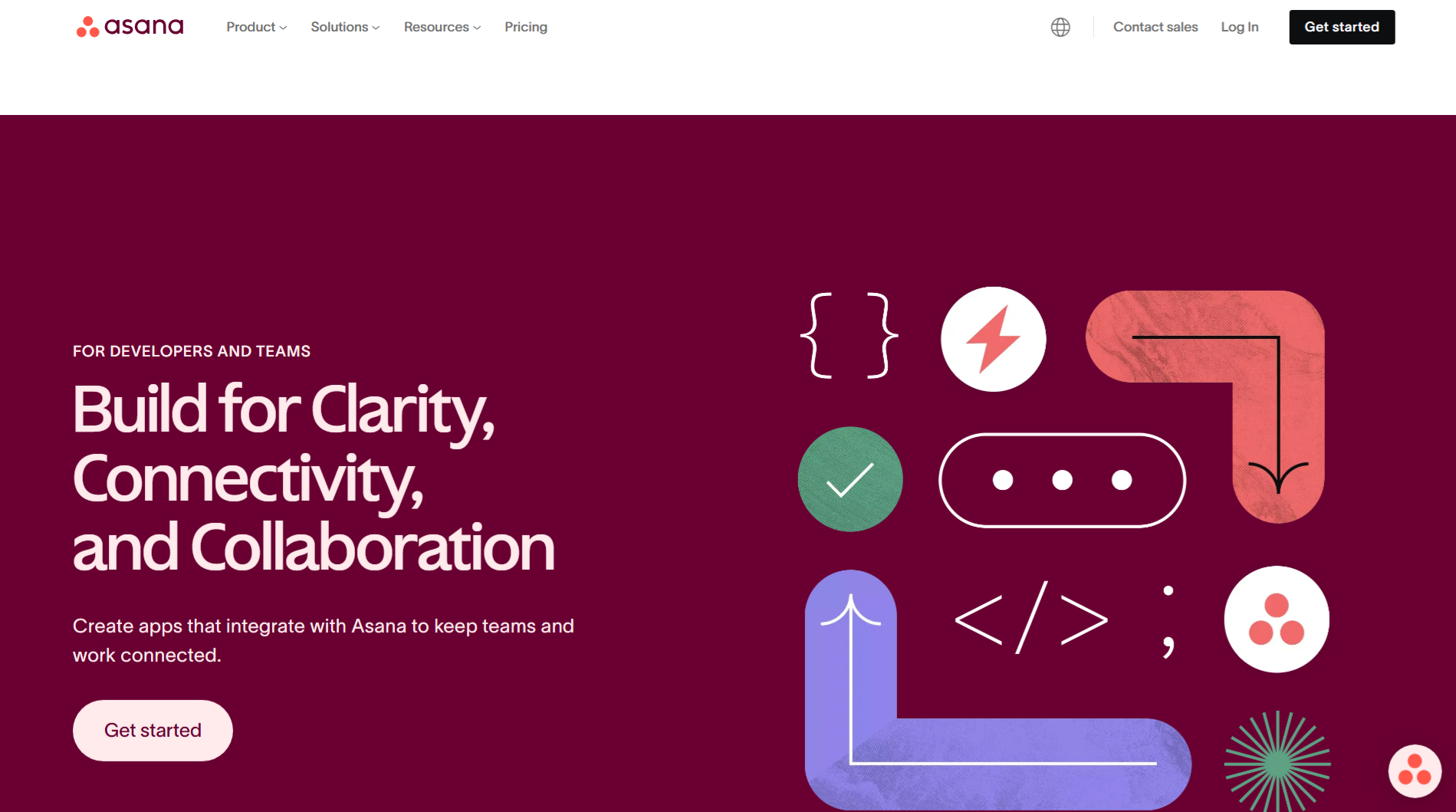
1. Visit [https://asana.com/developers/](https://asana.com/developers)
2. Click **"Get started"** or **"Login"** if you already have an account
3. Sign in with your Asana account or create a new developer account
 ## Step 2: Create a New App
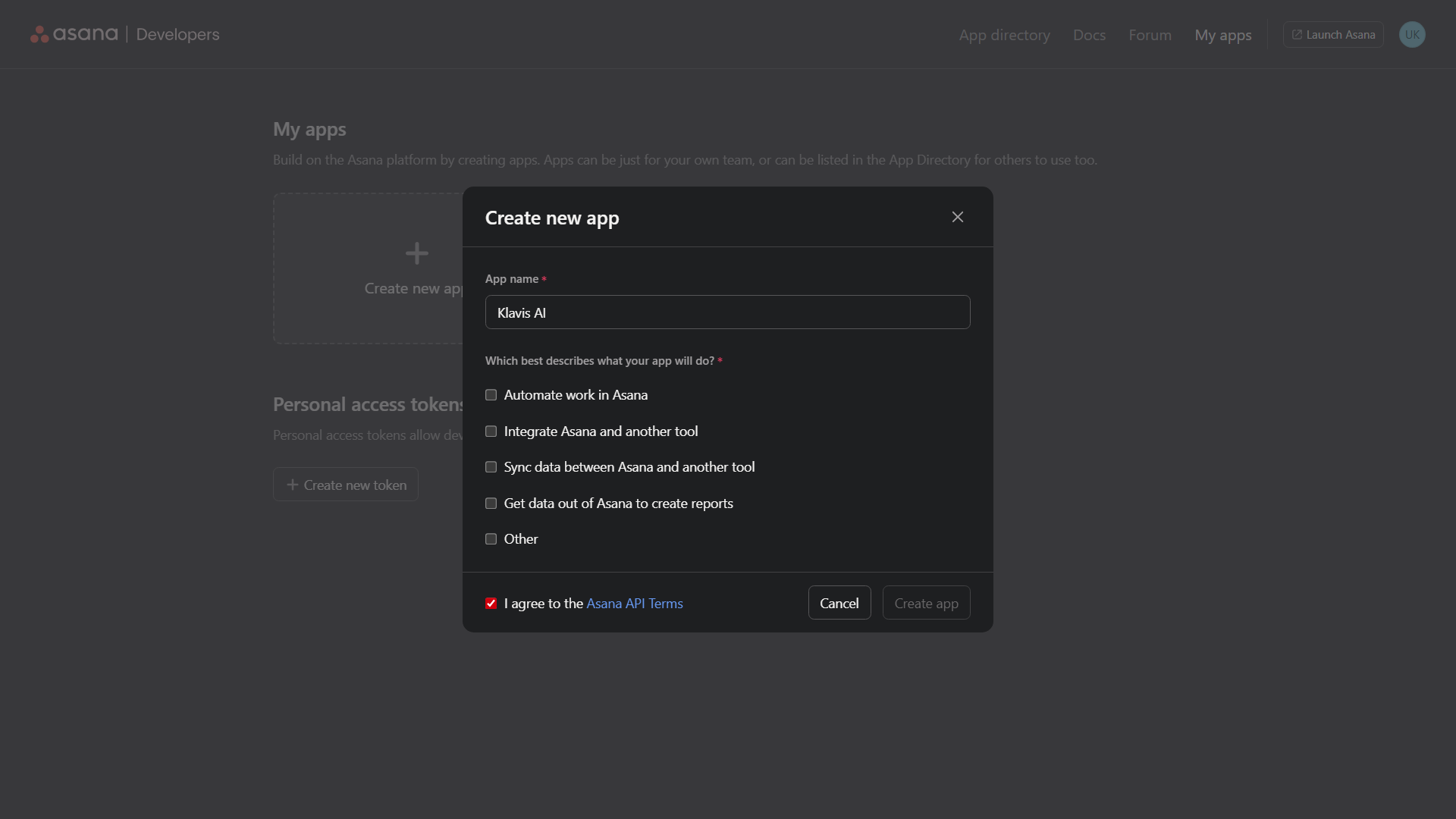
1. Once logged in, go to your settings -> **Apps**, and click **"Build new apps"**
2. Click **"Create new app"** under **"My apps"** section
3. Fill in the app details:
* **App name**: Your application name (e.g., your brand name)
* **Which best describes what your app will do?**: (Choose your preference)
* **Asana API Terms**: Agree to the terms and conditions
## Step 2: Create a New App
1. Once logged in, go to your settings -> **Apps**, and click **"Build new apps"**
2. Click **"Create new app"** under **"My apps"** section
3. Fill in the app details:
* **App name**: Your application name (e.g., your brand name)
* **Which best describes what your app will do?**: (Choose your preference)
* **Asana API Terms**: Agree to the terms and conditions
 ## Step 3: Configure OAuth Settings
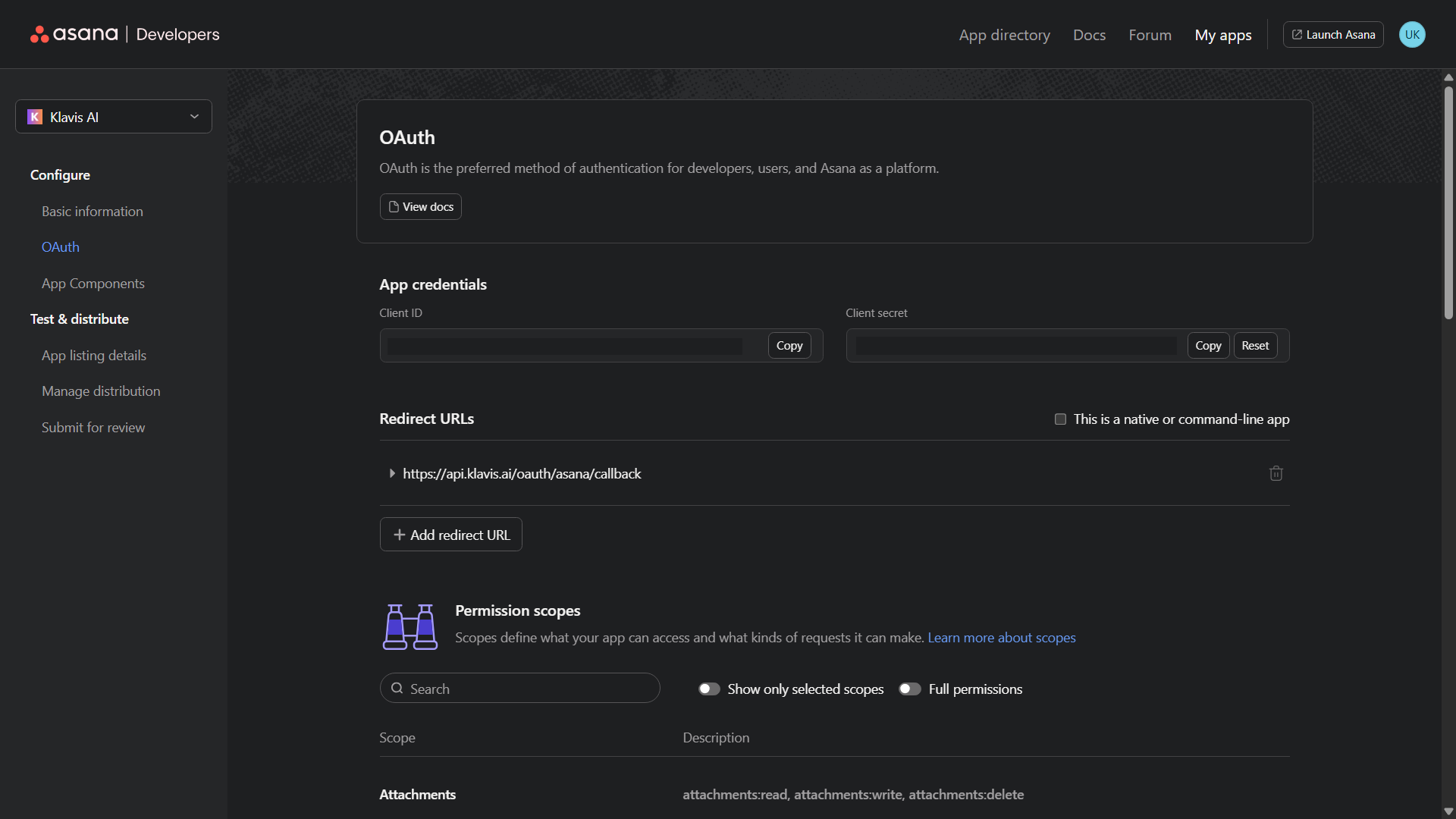
1. After creating the app, you'll see:
* **Client ID**: Copy this value
* **Client Secret**: Copy this value (keep it secure!)
2. **Redirect URIs**: Add your callback URL:
* `https://api.klavis.ai/oauth/asana/callback`
## Step 3: Configure OAuth Settings
1. After creating the app, you'll see:
* **Client ID**: Copy this value
* **Client Secret**: Copy this value (keep it secure!)
2. **Redirect URIs**: Add your callback URL:
* `https://api.klavis.ai/oauth/asana/callback`
 ## Step 4: Request Scopes
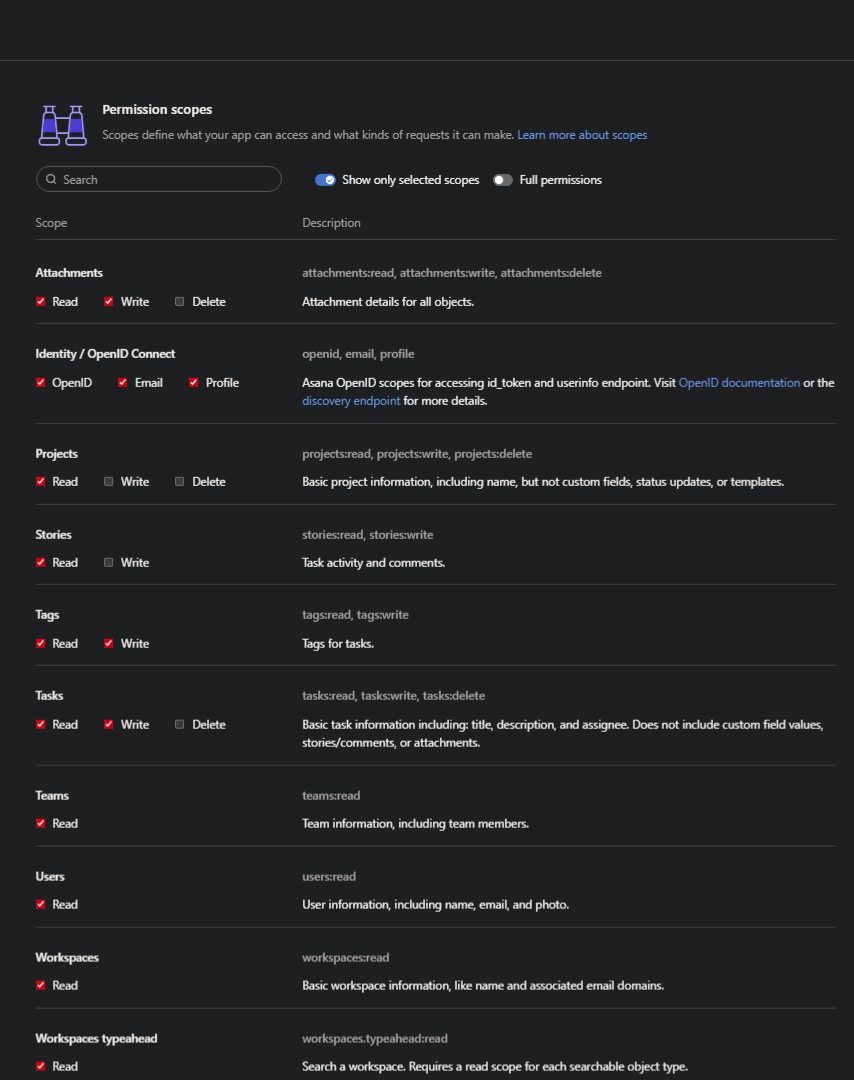
Klavis Asana MCP Server uses the following OAuth scopes: `goals:read,project_templates:read,projects:read,projects:write,projects:delete,stories:read,task_templates:read,tasks:read,tasks:write,tasks:delete,teams:read,users:read,workspaces:read,workspaces.typeahead:read`
1. Scroll to **"Permission scopes"** tab from **"Oauth"** menu
2. **Scopes**: Select the scopes your application needs:
## Step 4: Request Scopes
Klavis Asana MCP Server uses the following OAuth scopes: `goals:read,project_templates:read,projects:read,projects:write,projects:delete,stories:read,task_templates:read,tasks:read,tasks:write,tasks:delete,teams:read,users:read,workspaces:read,workspaces.typeahead:read`
1. Scroll to **"Permission scopes"** tab from **"Oauth"** menu
2. **Scopes**: Select the scopes your application needs:
 You have successfully created an Asana OAuth application! You now have your Client ID, Client Secret, and Redirect Url ready for integration with Klavis AI.
## (Optional) Step 5: White Labeling
White labeling allows you to customize the OAuth experience with your own branding instead of Klavis AI's.
If you want to use your own Asana OAuth application with custom branding:
1. **Configure White Labeling**: Go to [https://www.klavis.ai/home/white-label](https://www.klavis.ai/home/white-label)
2. **Add Your Credentials**: Enter your Asana **Client ID** and **Client Secret** from Step 3
3. **Set Redirect URI**: Use `https://api.klavis.ai/oauth/asana/callback` or your custom callback URL
4. **Initiate OAuth**: Use your client ID when starting the OAuth flow:
```javascript without SDK theme={null}
// Example: Initiating Asana OAuth with white-label
const authUrl = `https://api.klavis.ai/oauth/asana/authorize?instance_id=${instanceId}&client_id=${yourClientId}`;
window.location.href = authUrl;
```
```typescript TypeScript SDK theme={null}
import { Klavis } from "@klavis/sdk";
const klavis = new Klavis({
apiKey: "YOUR_API_KEY"
});
// Example: Initiating Asana OAuth with white-label
const oauthUrl = await klavis.mcpServer.getOAuthUrl({
serverName: Klavis.McpServerName.Asana,
instanceId: instanceId,
clientId: yourClientId,
// redirectUri: YOUR_REDIRECT_URI,
// scope: "YOUR_SCOPES",
});
window.location.href = oauthUrl;
```
```python Python SDK theme={null}
import webbrowser
from klavis import Klavis
from klavis.types import McpServerName
klavis = Klavis(api_key="YOUR_API_KEY")
# Example: Initiating Asana OAuth with white-label
oauth_url = klavis.mcp_server.get_oauth_url(
server_name=McpServerName.ASANA,
instance_id=instance_id,
client_id=your_client_id,
# redirect_uri="YOUR_REDIRECT_URI",
# scope="YOUR_SCOPES"
)
# Open OAuth URL in user's default browser
webbrowser.open(oauth_url)
```
For detailed white labeling implementation and code examples, see our [OAuth & White Labeling guide](/docs/auth/white-label).
## Resources
* [Asana OAuth Documentation](https://developers.asana.com/docs/oauth)
* [Klavis OAuth & White Labeling Guide](/docs/auth/white-label)
* [Klavis White Label Dashboard](https://www.klavis.ai/home/white-label)
You have successfully created an Asana OAuth application! You now have your Client ID, Client Secret, and Redirect Url ready for integration with Klavis AI.
## (Optional) Step 5: White Labeling
White labeling allows you to customize the OAuth experience with your own branding instead of Klavis AI's.
If you want to use your own Asana OAuth application with custom branding:
1. **Configure White Labeling**: Go to [https://www.klavis.ai/home/white-label](https://www.klavis.ai/home/white-label)
2. **Add Your Credentials**: Enter your Asana **Client ID** and **Client Secret** from Step 3
3. **Set Redirect URI**: Use `https://api.klavis.ai/oauth/asana/callback` or your custom callback URL
4. **Initiate OAuth**: Use your client ID when starting the OAuth flow:
```javascript without SDK theme={null}
// Example: Initiating Asana OAuth with white-label
const authUrl = `https://api.klavis.ai/oauth/asana/authorize?instance_id=${instanceId}&client_id=${yourClientId}`;
window.location.href = authUrl;
```
```typescript TypeScript SDK theme={null}
import { Klavis } from "@klavis/sdk";
const klavis = new Klavis({
apiKey: "YOUR_API_KEY"
});
// Example: Initiating Asana OAuth with white-label
const oauthUrl = await klavis.mcpServer.getOAuthUrl({
serverName: Klavis.McpServerName.Asana,
instanceId: instanceId,
clientId: yourClientId,
// redirectUri: YOUR_REDIRECT_URI,
// scope: "YOUR_SCOPES",
});
window.location.href = oauthUrl;
```
```python Python SDK theme={null}
import webbrowser
from klavis import Klavis
from klavis.types import McpServerName
klavis = Klavis(api_key="YOUR_API_KEY")
# Example: Initiating Asana OAuth with white-label
oauth_url = klavis.mcp_server.get_oauth_url(
server_name=McpServerName.ASANA,
instance_id=instance_id,
client_id=your_client_id,
# redirect_uri="YOUR_REDIRECT_URI",
# scope="YOUR_SCOPES"
)
# Open OAuth URL in user's default browser
webbrowser.open(oauth_url)
```
For detailed white labeling implementation and code examples, see our [OAuth & White Labeling guide](/docs/auth/white-label).
## Resources
* [Asana OAuth Documentation](https://developers.asana.com/docs/oauth)
* [Klavis OAuth & White Labeling Guide](/docs/auth/white-label)
* [Klavis White Label Dashboard](https://www.klavis.ai/home/white-label)